Who Shaped Early Film Scenes Before the Director’s Role Settled?
Who shaped early film scenes before directing became a settled role? Learn how to read visible choices without assigning creative work beyond the evidence.
The common mistake when asking who shaped early film scenes is to search the credits for a single director and treat that name as the answer. The cost is a flattened account of the scene: performers, camera operators and production teams can disappear from view, while an uncertain credit is made to carry more meaning than it can support.
Why can’t one credit explain the scene?
Early film production did not use one stable arrangement of creative roles across all companies and periods. A surviving credit may identify a producer, performer or studio, yet leave unclear who arranged movement, chose a camera position or coordinated the action. That absence does not prove that no one took responsibility; it limits what can be claimed from the record.
It is safer to describe the work before assigning it. A performer may have shaped timing, an operator may have chosen the frame, and a production organiser may have secured the setting and props. Those contributions can overlap, and the film alone may not tell us who proposed each one.
Later ideas about directing can also colour interpretation. Rather than assume every production had a single person exercising the full range of a modern director’s responsibilities, ask which decisions are visible and what contemporary records actually say about them.
What can performance tell us?
In a scene without recorded dialogue, movement and expression may carry much of the narrative. A performer’s entrance, pause, gesture or glance can guide attention and make an action readable. These are elements of performance, but they also affect the scene’s composition because they determine where attention falls within the frame.
Some performers had experience organising stage business or leading a troupe, and that background could inform how an exchange was arranged. A performer might suggest where to handle a prop or when another player should enter. Such a contribution is evidence of influence over that moment, not by itself evidence of control over the whole production.
How did the camera shape what could happen?
A fixed camera still involved choices. Its distance, angle and framing determined how much of the setting appeared and whether a performer’s movement remained visible. The chosen view could constrain staging: a gesture outside the frame could not help tell the story to the audience.
Camera operation should not be reduced to a purely mechanical task, but visual influence is not the same as sole authorship. Another person may have arranged the action, while the operator made practical decisions about recording it. Without supporting records, the image can establish what the frame contains, not who selected every detail.
Where did the production team’s influence lie?
Locations, costumes, props and schedules set conditions for a scene. Someone had to arrange these resources, and the available setting or objects could shape what performers were able to do. A producer or studio manager might control resources, while other workers handled daily coordination; job titles and responsibilities varied, so a credit needs to be read in its own context.
Useful questions are concrete: who could approve a location, arrange a prop or call for another take? A record that answers one of them can support a claim about that specific responsibility. It does not automatically establish who composed the frame or guided a performer’s timing.
How can you trace who shaped an early film scene?
Start with observations that another viewer could check, then separate those from claims about authorship. For each feature, decide whether the film itself supports the description or whether a production source is needed to name a contributor.
- Frame: If the camera holds the full action in view, record that visual fact; if a key movement leaves the frame, note the limitation rather than guessing who caused it.
- Movement: If an entrance, pause or gesture makes the action legible, describe its timing; if the cause of that timing is unknown, do not assign it to a director or performer.
- Props and setting: If an object or location affects the action, identify its visible role; if you need to name who supplied or chose it, look for a production record, otherwise leave the author unassigned.
- Credits: If a source names a role, report the credit as given; if it does not specify a particular creative decision, do not treat it as proof of that decision.
- Repeated choices: If several scenes share a staging feature, describe the pattern; if no source identifies its origin, avoid naming a single person as its creator.
- Conflicting records: If sources disagree about a role, state the disagreement and qualify the attribution; if the conflict cannot be resolved, describe the scene without choosing a side.
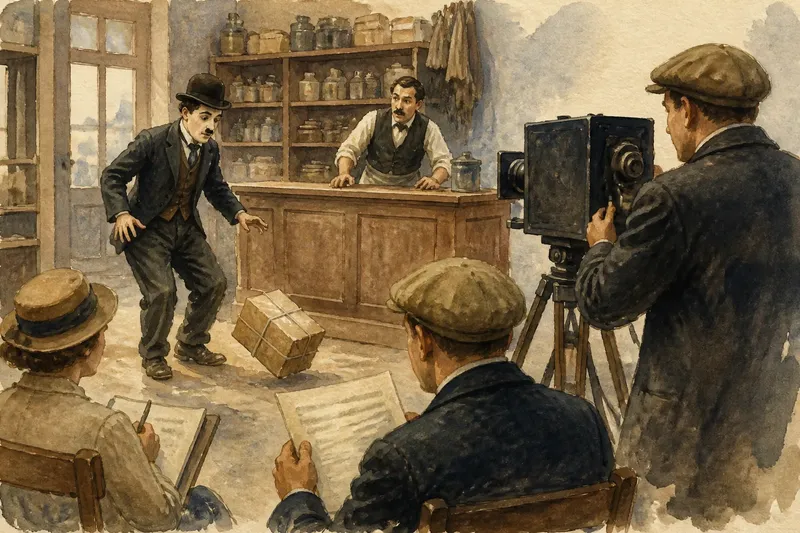
Say you are examining an invented short scene: a performer enters a shop, drops a parcel, and turns towards another performer. You note that both figures remain in the frame, the parcel’s fall is visible, and the second performer reacts afterwards. You then check a hypothetical production note that names a camera operator but says nothing about staging. The resulting account can attribute the framing only as far as that note supports, while describing the performers’ timing as visible evidence without claiming who planned it.
Which questions help distinguish the roles?
Did early films have directors?
Some people carried out directing-like tasks, but the duties and titles were not uniform across productions. A credit or film may reveal part of the arrangement without identifying who controlled every creative decision.
Could a camera operator shape the scene?
Yes: framing and camera placement affected what the audience could see. That visual contribution does not establish that the operator also arranged the performance or managed production.
Could a performer guide other players?
A performer could contribute to the timing or arrangement of an action, particularly where stage experience or troupe leadership was relevant. The scene may show coordinated movement, but a claim about who directed it needs corroborating evidence.
What can the film itself prove?
The image can show where performers stand, how they move and what falls within the frame. It rarely identifies the person who made each choice, so use production records for attribution and qualify claims when those records are incomplete.
What is not worth the effort?
It is not useful to force an early production into a modern crew chart or to invent an author for every framing or movement choice. A careful description of what can be seen is more informative than a confident attribution that the available evidence cannot support.
For anyone asking who shaped early film scenes, the most useful answer may be a division of visible work rather than one name: performers made actions legible, camera operators controlled what entered the image, and production teams arranged practical conditions. Keep those observations distinct from claims about individual responsibility; that small discipline makes the scene’s craft clearer without turning uncertainty into false certainty.