The Continuity Error Is Not Always the Point
A continuity error does not always damage a scene. Learn which shot mismatches distract, which fade into the story, and how to tell the difference.
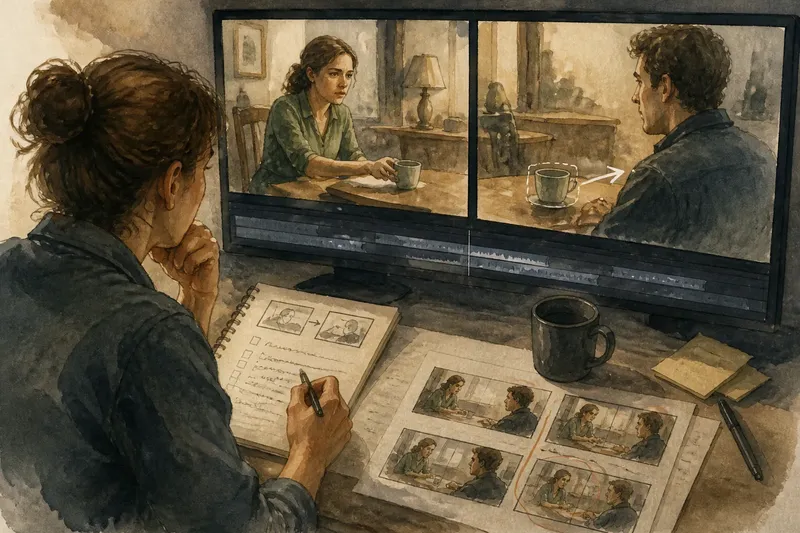
The common mistake in spotting a continuity error is to treat every mismatch as a broken scene. A character’s glass may lose a little water between shots, or a sleeve may shift; if the change pulls attention away from the action, it matters. If it passes unnoticed while the scene’s meaning remains clear, the discrepancy may be harmless—or even serve the edit.
Continuity editing is the practice of joining shots so that time, space and action feel coherent. That does not mean every prop must remain in precisely the same position. The useful question is whether a change interrupts the viewer’s understanding or attention. These distinctions help explain why a conspicuous error can jar, while a technically imperfect cut can feel entirely natural.
1. Does the mismatch interrupt the scene?
A continuity error becomes distracting when the eye catches it before the story does. A character reaches for a cup in one shot, but in the next the cup is already across the table, with no visible movement to account for the jump. If the cup is prominent and the conversation depends on the character’s hesitation, the change can pull attention away from that hesitation.
By contrast, a small change near the edge of the frame may never register. A cushion might be slightly compressed in the reverse shot, yet the exchange still reads clearly because the faces and dialogue hold attention. The physical mismatch remains, but it has not necessarily damaged the viewing experience.
Try separating the observation from its effect: first name what changed, then ask whether you looked away from the scene’s action to inspect it. Noticing a discrepancy on a deliberate pause or second viewing does not automatically mean it disrupted the first. The difference is between recognising an edit and being diverted by it.
2. Does the change alter what the viewer understands?
Some mismatches matter because they change the apparent sequence of events. If an actor’s hand is raised in one shot and suddenly lowered in the next, the cut may suggest a movement that was never shown. That can confuse the timing of a response or make a character seem to act before hearing something.
Other changes are merely cosmetic. The level of liquid in a glass may vary between takes, but if nobody drinks, pours or refers to it, the scene’s action still makes sense. A detail becomes more consequential when the story gives it a job: a missing key, a switched document or a door that changes from open to shut can affect what the viewer believes has happened.
Imagine a scene in which one character slides a letter across a desk. In the first shot, the envelope sits near the desk lamp; after a close-up of the recipient’s face, it appears nearer the edge. If the recipient then picks it up, the new position may read as part of the action, and the exchange remains easy to follow. If the letter vanishes before the recipient touches it, the viewer may wonder who moved it, shifting attention from the decision the scene is building toward.
3. Is the viewer looking at the detail?
Framing and performance affect how closely a mismatch is watched. A bright object held against a plain background is easy to track. A similar object in a crowded frame may be less noticeable, especially while the actors’ faces carry an emotional exchange.
Editors often cut according to attention: a glance, a movement or a change in the dialogue gives the viewer a reason to look elsewhere. The sound can help, too. A line delivered over a close-up may keep the ear and eye with the speaker while a background object changes in the next shot. None of this makes continuity irrelevant; it explains why the same discrepancy can be glaring in one scene and negligible in another.
When examining a cut, look at what the frame emphasises, not only what has changed. Ask whether a gesture, face or sound cue directs attention to the mismatch. If the object is central to the shot, the edit has less room for unnoticed variation.
4. Does the cut preserve a useful rhythm?
A cut may omit the exact physical movement between two positions while preserving the action’s emotional rhythm. For instance, the audience sees a character begin to reach, then cuts to the other person’s reaction before the hand arrives. The missing motion can make the exchange feel brisk and keep the reaction in focus.
Here, continuity is not simply a record of where every limb was. The edit is shaping what the audience attends to and when. A technically precise match can still feel sluggish if it lingers on a movement the scene does not need; a small jump can feel clean if the action and intention remain legible.
This is why a mismatch should be judged in the whole passage rather than as a frozen pair of frames. Watch the lead-in and the reaction after the cut. If the scene’s pace, gesture and emotional turn carry through, the cut may be doing more useful work than a perfect match would.
5. Which continuity errors are worth examining?
When reviewing a scene, use a short set of questions to distinguish a visible variation from a genuine distraction:
- What changed? Name the object, gesture, costume detail or position without judging it yet.
- Where is it in the frame? A prominent detail is more likely to draw attention than a background one.
- Does the change alter the action? Check whether it makes a movement or event hard to understand.
- What holds attention at the cut? Notice the actor’s face, dialogue, sound cue or movement.
- Does the scene recover immediately? If attention returns to the story without confusion, the variation may have little effect.
- Does the detail matter later? A prop that becomes important may need closer continuity than one that never affects the scene.
These questions are for viewing, not a rulebook for condemning scenes. A detail can be easy to spot and still have no meaningful effect. The review becomes more useful when it records the consequence—confusion, a broken reaction, or no noticeable interruption—rather than merely collecting mismatches.
What should you ask about a continuity error?
Does every continuity error count as a mistake?
Not every mismatch damages the scene, and some apparent inconsistencies may be deliberate. A visible variation matters most when it distracts from the action or changes what the viewer understands.
Why do continuity errors become more noticeable on a second viewing?
A second viewing gives you time to inspect objects and cuts instead of following the story for the first time. That extra attention can reveal details that did not interrupt the original viewing experience.
Can a continuity error help a scene?
A mismatch is not helpful merely because it exists, but a cut that omits a movement can keep attention on a reaction or maintain pace. Judge the effect of the edit, rather than treating every missing match as a flaw.
What is not worth the effort when reviewing continuity?
There is little value in cataloguing tiny background changes that neither affect the action nor attract attention. Spend that effort on details that alter a gesture, a prop’s meaning, or the viewer’s grasp of who did what.
Why does the whole scene matter more than a perfect match?
Continuity errors are easiest to assess when you connect the mismatch to the viewing experience. A glass that shifts slightly may be irrelevant; a letter that disappears before anyone collects it may interrupt the scene’s logic. In both cases, the useful evidence is what happens to your attention and understanding at the cut.
For a scene you are watching closely, note the change, then replay the passage without pausing. If you follow the same intention and action without effort, the variation may not deserve further concern. If you keep tracking the object instead of the people, the continuity error has become part of the scene’s experience—and that is the point worth examining.